Wet Yards Over a Fragipan, Dry Ones on the Rathdrum Prairie: Drainage Around Coeur d'Alene
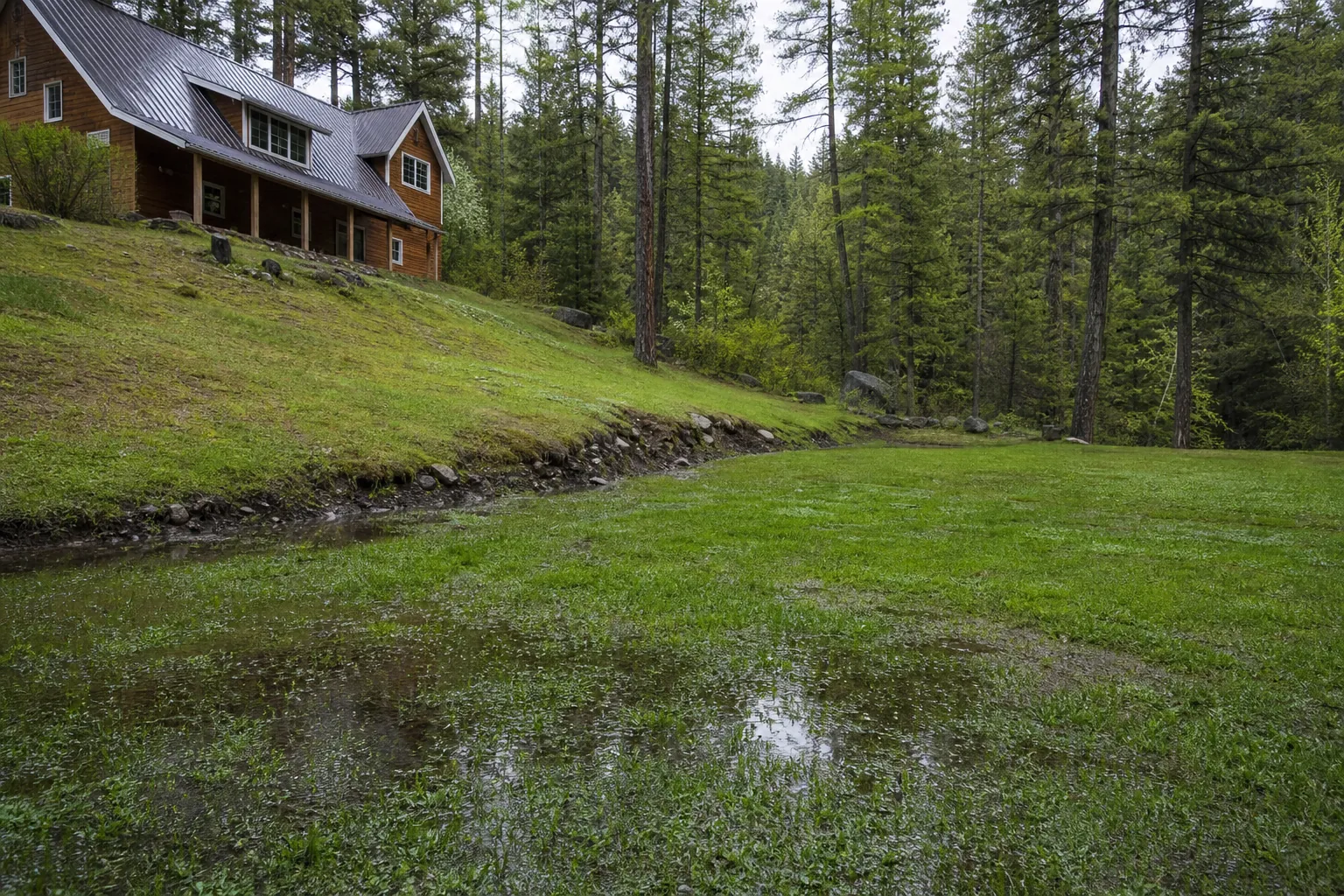
A yard in the timbered hills around Coeur d'Alene can stay soggy from December into May, while a lot a few miles away on the Rathdrum Prairie barely holds a puddle. Both are normal Panhandle ground. They need opposite fixes, so the first job is working out which one you are standing on.
Two kinds of Panhandle ground
The uplands carry soils built in layers: a cap of volcanic ash over windblown silt called loess, with a dense layer called a fragipan below. The Santa series is a good local example. Its type location is Harrison Flats in Kootenai County, and the NRCS official description of the Santa soil puts the fragipan 50 to 100 cm down, roughly 20 to 39 inches, with a perched water table 45 to 68 cm below the surface from December through May.
The prairie is built differently. The U.S. Geological Survey's study of the Spokane Valley-Rathdrum Prairie aquifer describes it as mostly gravels, cobbles and boulders laid down by the outburst floods of ancient Glacial Lake Missoula. NRCS rates outwash soils such as the Garrison series, which is mapped in Kootenai County, as somewhat excessively drained. Water goes straight down.
A shovel in March or April usually settles the question. In the wettest part of the yard, dig a hole about three feet deep, which reaches the pan in most of the soil descriptions below, and come back to it later in the day. If water seeps in from the sides and stands on a tight layer the blade barely scratches, you have pan ground. If the hole is gravel and rounded cobble and stays dry, you are on the prairie.
Ash cap and fragipan: why water sits
The Soil Science Society of America's booklet on Threebear, Idaho's state soil, explains the layering in plain language. The ash came from the eruption of Mount Mazama, now Crater Lake, about 7,600 years ago, and in Threebear soils it runs 14 to 23 inches thick. Below it the loess has packed into a fragipan at 23 to 40 inches that the booklet calls "not permeable to water and plant roots."
The consequence is simple. Rain and snowmelt soak through the ash, hit the pan and stop. Through the wet winter and spring, in the booklet's words, that water "collects above the fragipan and creates a water table," and it lists roads, streets and houses with basements among the uses the seasonal water limits. On a slope, water held up by the pan has nowhere to go but sideways and downhill along the top of it, so the low side of a lot or the cut bank of a new drive can stay wet after the rain has stopped.
Regrading the surface helps with what falls on your lot. It does nothing for water arriving underground from the hill above you. That water has to be caught.
Rathdrum Prairie: why water vanishes
Down on the prairie the problem flips. In its 2007 report, USGS called the aquifer under it the sole source of drinking water for more than 500,000 people, and the urban areas it supplies include Coeur d'Alene and Post Falls. The same report lists infiltration from precipitation, landscape irrigation and septic systems among the ways water gets into it.
So a prairie lot rarely needs help draining. It needs care about what the water carries down, because whatever soaks into that gravel is headed for the same water the towns pump. If you are building there, the Post Falls ground notes cover which materials suit prairie lots.
Curtain drains above a fragipan
A curtain drain is a trench dug across the slope on the uphill side of whatever you want dry: the house, a drive, a vegetable garden. It catches water riding on the pan and carries it around to lower ground. Three things decide whether it works.
Depth comes first. The trench has to reach the dense layer, because the water travels on top of it, and a trench that stops in the ash lets water slip underneath. In Santa and Threebear soils that means somewhere around 20 to 40 inches, so dig a test hole and find your own number. Dig in August or September, after the perched water listed for December through May has dropped, and you will see the pan without a pool in the bottom of the trench.
The second is the outlet. The Federal Highway Administration's Gravel Roads Construction and Maintenance Guide describes the same build under road beds: a trench cut to grade, perforated pipe, clean small stone around it and a geotextile lining that helps the drain last. The guide is firm that the pipe must run out to an open end, level with the ditch bottom or nearly so, and it warns that an outlet sitting in standing water can make the pipe work backwards. On fragipan ground the open end is the whole design. A dry well dug down to the pan is no substitute: it would sit in the same perched water, on a layer the SSSA booklet calls not permeable to water. If the lot has no lower ground to daylight to, talk to the city or county before you dig.
The third is the stone. Drain rock for curtain drains here is washed to remove fines and dust and runs 3/4 inch to 1-1/2 inch, which leaves open gaps for water to move through. Its product page calls for lining the trench with non-woven drainage fabric lapped at least 12 inches, and allows about one ton of drain rock per 10 feet of a trench 12 inches wide and 24 inches deep. A 100-foot curtain drain that size takes about 10 tons, a little less once the pipe is in. Run a deeper or wider trench through the stone calculator.
Raised pads on pit run and road mix
For a shed, a hot tub or a parking pad on pan ground, keep the finished pad above the ground around it. Cut a pad down into the wet layer and it collects the perched water every spring. Take off the sod and topsoil, lay woven geotextile where the subgrade is soft, and bring the pad up high enough that water can leave it on every side.
Pit run for raised pads is sold here for compacted sub-base and for building up low spots, and the listing gives it as 3/4 inch minus crushed stone with its fines. Cap it with 3/4 road mix, whose stone and gravel come in a range of sizes with binding fines among them, so it closes up into a firm base under compaction. Compact each layer before the next one goes on.
Plan the delivery around the wet months too. The delivery checklist asks for a 12-foot-wide route with no low branches or wires and a clear, level place to unload. In April that place is usually the driveway, not the soggy lawn you are trying to fix.
Protecting the aquifer
The City of Coeur d'Alene's stormwater page spells out the route: runoff flows into catch basins, storm drains, swales, culverts, ditches and drywells, and eventually into the lake and the aquifer, carrying lawn chemicals, oil, grease, pet waste and sediment with it. The city's stormwater FAQ adds that part of its system sends water from curbs, gutters, ditches and swales to shallow injection wells regulated by the Idaho Department of Environmental Quality and the Idaho Department of Water Resources.
On a prairie lot that means two habits. Keep the grassy swale along your street working: the city asks owners to mow it and to clear "sod dams" that build up in front of the drain openings, and says water standing in a swale for a while after a heavy rain is normal. And keep spills off open gravel. Change oil over a drain pan, soak up spills with cat litter or sawdust and sweep them into the trash, and sweep the driveway instead of hosing it into the street.
Before you add a drywell, or send a downspout into a pit of rock, ask the city's streets and engineering office, or Kootenai County if you are outside city limits.
Dig the test hole in spring, while the perched water is still up. If it fills, plan the curtain drain around its outlet before you work out a single ton of drain rock. If it stays dry, the ground is draining itself, and your effort belongs in the street swale and in keeping spills off the gravel.